Networked Learning Project Blog Post #3
I am the type of person that needs multiple ways to explain new information. Whether that be a combination of verbal instructions, an image, video, text, or others. The more ways to explain information, the better. Some may call this being stubborn, I call it using my resources. That being said, when it came time to learn how to do the splits, I was overjoyed to learn that I needed to use multimodal tools to help me learn. That sent my Type A self into motion to organize my research.
I knew in previous MAET classes about the dangers of cognitive overload. Cognitive overload is when "more information than a person can process" is presented in the working memory (Malamed, n.d.). This prior knowledge allowed me to near transfer (Bransford et al., 2000, p. 53) the concept of cognitive overload onto the Networked Learning Project. I bring up cognitive load because I find that the internet can be an overwhelming place to find new information. One simple Google search can bring up thousands of results. To stop myself from processing too much new information at once, I made a spreadsheet to house all of my information while researching. The spreadsheet below shows my thought processes while researching how to do the splits.
The sources that I used to learn how to do the splits.
Over the process of learning how to do the splits, I learned not only how to contort my body in somewhat unnatural ways, but about how learners can retain information online. One way that I noticed I was more able to retain the information about stretching was when the information was presented in a multimodal fashion. According to Antsey and Bull (2010), "A text may be defined as multimodal when it combines two or more semiotic systems." This means that a text is multimodal when it combines aspects of language, visuals, audio, gestures, and/or spatial awareness. I found that when I only had the modality of linguistics (or just visuals) available for me, it was harder for me to process the information that was being presented. When there was a combination of audio and visuals, or linguistics and visuals (for example), I was able to process the information better and allow me to apply it to my own learning.
Another thing that I didn't necessarily learn through this project, but it was definitely solidified in my future practices, was the importance of complete prior understanding. In my second blog post, I discussed how a previous injury was holding me back from achieving my splits. This setback was mainly caused by a misunderstanding that was not built on. Bransford et al. (2000) says that teachers need to watch for incomplete understandings and build on them in order for the student to have a more mature understanding of the concept (p.10). This did not happen to me when I was learning the art of stretching, or lack thereof. Instead, because of my incomplete knowledge that was not built on, I ended up getting injured. Thinking back on it, this is probably why I was never able to get my splits during my ballet tenure. If I were to have learned the importance of thoroughly stretching after any athletic activity, this could have been avoided and I may or may not have had my splits by now. This idea of incomplete understanding in my own learning is helping me in my teaching practices to recognize the importance of checking for complete understanding in my students.
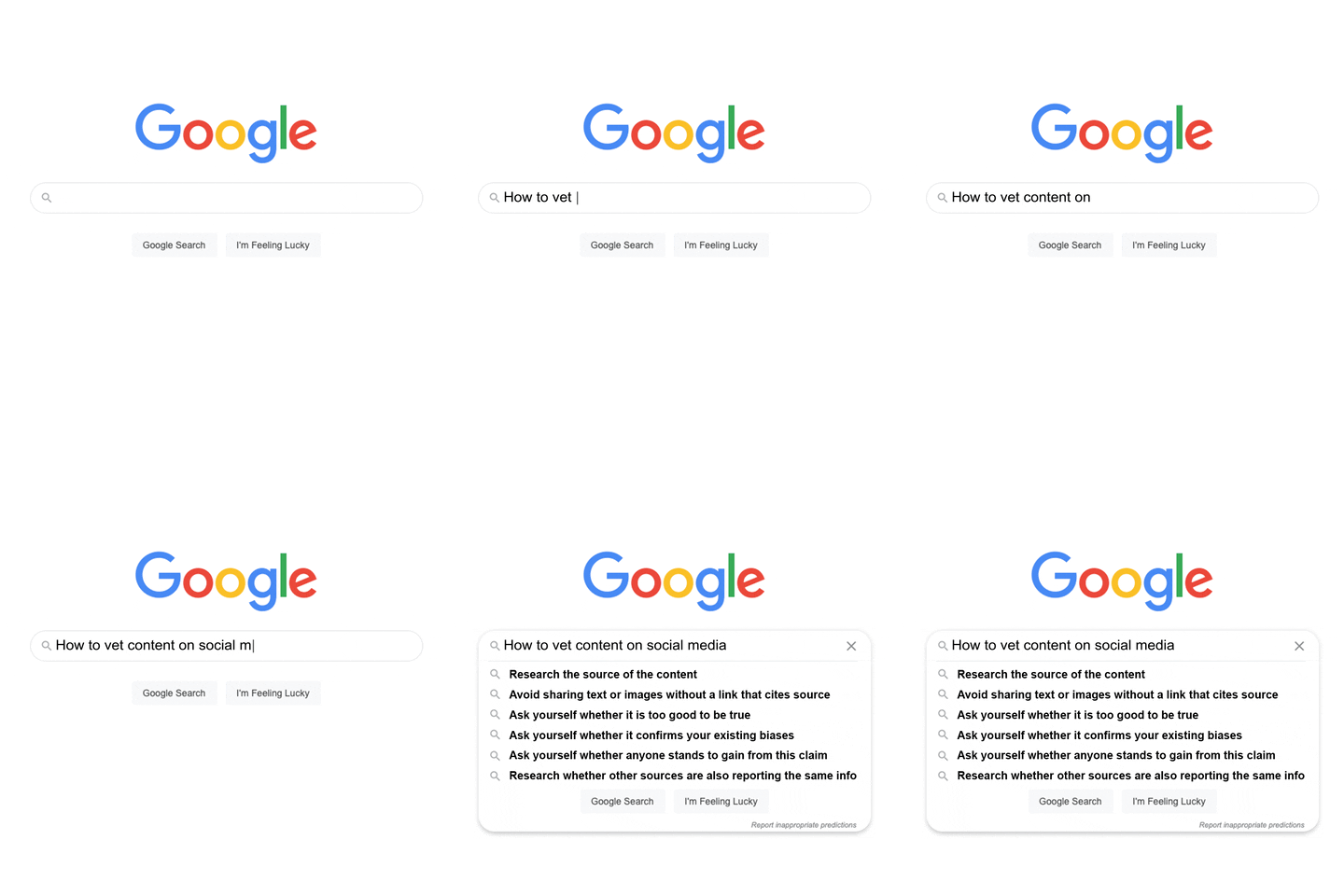
Long ago (but not really) were the days that any and all information had to come from hardcover textbooks or physical materials. Thankfully, by the expansion of internet reach, there can be a more equal access to information. Now that there is a device in the majority of households in the United States, there is a very good chance that research projects will now become fully digital. I believe that networked learning may be the way to go about this task. This means that there needs to be explicit instruction in classrooms from a young age on how to use the internet to find credible, reliable sources of information. Teaching the younger generations how to source credible information to use in a resourceful way will be an important skill to master for their futures. The sooner they start this practice, the better.
Look Back on My Progress!
NETWORKED LEARNING PROJECT BLOG #1
NETWORKED LEARNING PROJECT BLOG POST #2
References:
Anstey, M., & Bull, G. (2010). Helping teachers to explore multimodal texts. Curriculum and Leadership Journal. http://www.curriculum.edu.au/leader/helping_teachers_to_explore_multimodal_texts,31522.html?issueID=12141
Bransford, J., Brown, A.L. & Cocking, R. R. (2000). How people learn: Brain, mind, experience and school. National Academy Press. http://www.nap.edu/openbook.php?isbn=0309070368.
Malamed, C. n.d. What is cognitive load?. The eLearning Coach. https://theelearningcoach.com/learning/what-is-cognitive-load/
Swenson, L. (2022, August 19). Splits in 6 Weeks | Can I do it? [Video]. YouTube. https://youtu.be/VMEt3iib1Pc
Image Credit
Women's March. (2021, March 30). Social Media Google GIF. Giphy. https://media.giphy.com/media/TwSB11SXv5q9Kcpzny/giphy.gif


Comments
Post a Comment